


MCF 2026 Preferred Pricing introduces tiered discounts and FBA credits for sellers using Amazon’s Multi-Channel Fulfillment. Starting January 15, 2026, eligible sellers can receive up to 15% off outbound MCF fees plus $1 in FBA credit per unit shipped. However, the FBA credit has a hard cap of $50,000 (or 100,000 units), while the percentage discount continues beyond that threshold.
That distinction changes your unit economics.
If you’re shipping high volumes, you’ll exhaust the credit quickly and move into a discount-only phase. Smaller or mid-volume sellers may see a higher effective savings rate per unit because they benefit from both incentives across their entire forecast.
In this guide, we’ll break down how MCF 2026 Preferred Pricing actually works, explain the $50K credit ceiling, walk through both enrollment paths, and show you how to model the program accurately in your P&L. If you’re expanding off-Amazon channels or testing new demand streams, understanding this structure is essential before you project your margins.
MCF 2026 Preferred Pricing is Amazon’s incentive program designed to increase Multi-Channel Fulfillment adoption. Sellers receive:
The maximum benefit is:
This applies beginning January 15, 2026.
You can review official program mechanics in Amazon’s Multi-Channel Fulfillment 2026 Preferred Pricing Terms.
External Resources: Multi-Channel Fulfillment 2026 Preferred Pricing

Here’s where most sellers miscalculate.
The FBA credit is capped at:
The percentage discount has no financial cap.
If you ship 50,000 units at the $1 credit level, you’ve reached the ceiling. Every shipment beyond that point earns only the percentage discount.
Example:
Seller A’s effective savings rate per unit may actually be higher.
.svg)
There are two entry tracks:
.svg)
Amazon structured MCF 2026 Preferred Pricing around two very different seller profiles
The 6-month program is designed for sellers who are either new to MCF or just starting to integrate it into their fulfillment strategy. You qualify if you’ve shipped at least 100 MCF units through the New Seller Incentive (NSI) program after October 15, 2025, started using an MCF API integration after that date, or you’re an established FBA seller with strong FBA volume (5,800+ units in the past 12 weeks) but limited MCF activity (fewer than 1,200 units).
The benefit here is straightforward and fixed: 15% off MCF outbound fees plus $1 FBA credit per unit shipped, capped at $50,000 in credits. There’s no tiering during this 6-month window. It’s predictable and front-loaded to encourage testing.
The 12-month program works differently. It’s performance-based and recalculated weekly. To qualify, you must have shipped between 1,200 and 23,000 MCF units in the past 12 weeks. Instead of a fixed benefit, your discount and credit scale with your rolling 12-week volume. The higher your recent volume, the higher your percentage discount and per-unit credit, up to the full 15% and $1.
However, benefits apply only to your first 100,000 MCF units or 12 months, whichever comes first. And if your rolling 12-week volume drops below 1,200 units, you lose both the discount and the credit for that week.
Benefits depend on volume:
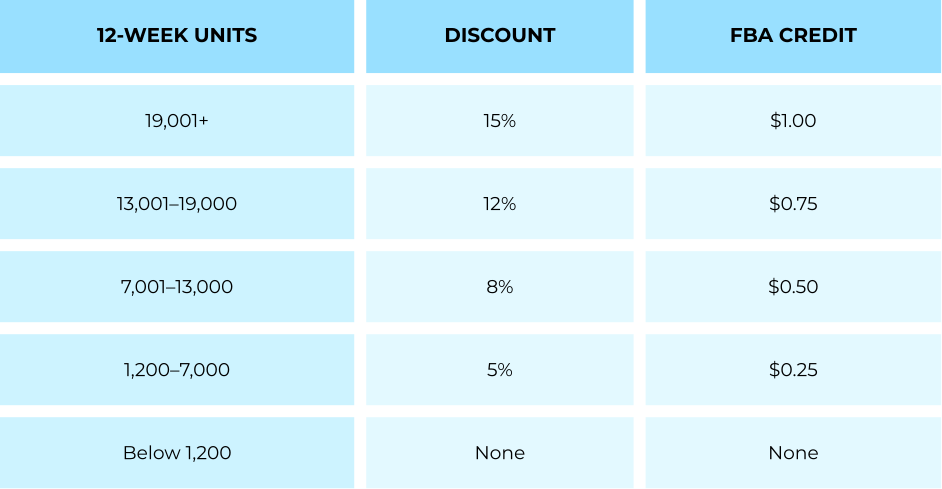
Amazon recalculates weekly based on a rolling 12-week window.
Amazon evaluates your shipping activity weekly.
Every Saturday:
If your volume drops below 1,200 units, you lose all benefits for that week.
.svg)
This program rewards adoption, not pure scale.
The ideal beneficiaries:
If your AOV supports MCF economics, the 15% discount remains valuable even after the credit runs out.
For deeper FBA vs MCF comparisons, see:
Model in two phases:
If you ship ~4,200 units per month at $1 credit, you’ll hit $50K in about 12 months. Higher volume? You hit it sooner. Your Q3 forecast could diverge from Q1 savings.
.svg)
MCF 2026 Preferred Pricing is not just a discount program. It’s a volume-structured incentive system with a defined ceiling. The FBA credit cap changes effective unit economics for high-volume sellers, while mid-volume operators may benefit more proportionally.
Amazon structured this program to drive MCF adoption and cross-channel growth. If you understand where the cap sits in your forecast, you can use it strategically instead of reactively.
Before expanding off-Amazon channels using MCF, build a model that separates credit-driven savings from discount-only economics.
We are your Amazon experts who provide comprehensive solutions and guidance to drive e-commerce businesses closer to success.
%20Cover%20Pic%20Template%20(4).png)