


Amazon SEO is not a one-time task. It is an ongoing, data-driven system that determines whether your product appears on page one or disappears into irrelevance. The sellers who consistently capture organic traffic on Amazon are not the ones who wrote the best bullet points, are the ones who treat keyword indexing as a living strategy.
Amazon's A9 algorithm ranks products based on a combination of keyword relevance, conversion rate, sales velocity, and click-through performance. Every variable in that equation is something you can influence, but only if you understand the mechanics behind each lever.
At Online Seller Solutions, we have built for you a structured, 4-step Amazon SEO system designed to compound ranking gains over time. Each step builds on the previous one, moving from foundational search term optimization all the way to market share indexing using Amazon's own Search Query Report data. Whether you are launching a new product or managing a mature catalog, this framework gives you a clear operational path to higher rankings and better P&L outcomes.
Most sellers think about Amazon SEO in terms of visibility. That framing undersells the financial stakes.
Here is what is actually happening: every position your listing climbs in organic search results reduces your dependency on paid advertising. When a product ranks organically for high-volume keywords, your Advertising Cost of Sale (ACoS) drops because you are capturing traffic without spending. That margin improvement flows directly to your net profit.
The inverse is equally important. A listing with poor keyword indexing forces you to compensate through Amazon PPC spend.
You are essentially paying to appear where you should already be ranking for free. Over time, this creates a structural inefficiency in your P&L that compounds every month you fail to fix it.
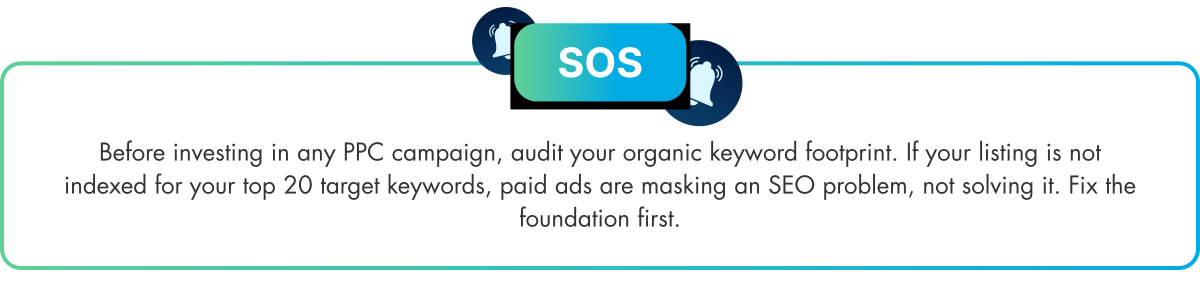
The relationship between organic ranking and profitability is direct and measurable. Products that rank in positions 1 through 19 for a keyword capture the vast majority of organic clicks. Products ranked 20 through 50 exist in what we call the Ranking Threshold Keywords, a range where relatively small improvements in ranking produce significant gains in traffic and conversion. We will return to this concept in Step 3.
Amazon's A9 algorithm is a ranking engine trained on one objective: predict which product listing is most likely to result in a completed purchase for a given search query. That single objective drives every ranking decision the algorithm makes.
The algorithm evaluates several factors simultaneously. Keyword relevance determines whether your product is even eligible to appear for a search term, conversion rate signals whether shoppers who find your product actually buy it, and sales velocity tells the algorithm how much consumer demand your product is generating over time. Click-through rate indicates whether your title and main image are compelling enough to earn the tap, while reviews and ratings serve as social proof signals that influence both conversion and ranking weight.
What has changed meaningfully in 2026 is the growing influence of AI-powered tools like Amazon's Rufus, the conversational shopping assistant. Rufus parses product listings semantically, not just syntactically. This means a title stuffed with exact-match keywords but written without logical structure may underperform compared to a well-constructed title that answers a buyer's likely intent.

Related: Boost Your Sales With Amazon SEO
Before any structured SEO strategy can work, your listing must meet a baseline of structural integrity.
These six pillars are the operating requirements for any ranking gains to hold.
1. Keyword Research is the starting point, tools like Amazon's Product Opportunity Explorer and purpose-built platforms allow you to identify high-volume keywords as well as long-tail phrases that indicate strong purchase intent. The goal is a ranked keyword universe, not a flat list.
2. Product Titles carry the most algorithmic weight of any on-page listing element, so your primary keyword must appear in the title, and it should appear early. Titles must also be structured for mobile readability, since the majority of Amazon traffic now comes from mobile devices where titles are truncated after the first 80 characters.
3. Product Imagery and Video influence click-through rate, which feeds back into your ranking. A minimum of five to seven high-resolution images, including a clean white-background main image, lifestyle photography, and contextual views, is the current baseline. Listings with video consistently outperform those without in both conversion rate and time-on-page metrics.
4. Bullet Points and descriptions are where medium-volume keywords earn their place. Benefits-first writing that integrates keywords naturally converts better than feature-heavy lists written for search bots. Both elements matter for indexing, but conversion is the downstream goal.
5. Backend Keywords represent one of the most underutilized levers in Amazon SEO. Seller Central provides a 249-byte limit in the search terms field. That space should be used to index synonyms, alternate spellings, Spanish-language terms, and long-tail phrases that are not represented anywhere in your visible copy. Wasted bytes here are wasted ranking opportunities.
6. Conversion and Performance function as a feedback loop. The algorithm rewards what converts. Improving your listing's CTR and conversion rate signals product-market fit to A9, which accelerates organic ranking gains.
External resources:
The foundation of the OSS Amazon SEO system is a complete overhaul of your backend search terms. This is where most sellers lose the most ground without knowing it.
The typical seller fills their search term field with whatever keywords felt relevant at launch. Over time, that field collects redundant terms, duplicate words already indexed via the title or bullets, and low-value filler phrases that consume bytes without contributing to ranking. The result is a backend that actively limits your indexing potential.
Step 1 recommendation is to start with a few ASINs before doing a full audit of existing search terms.
The audit surfaces low-value terms: words already indexed through visible copy, superfluous terms that Amazon's algorithm does not recognize as meaningful (such as "amazing," "new," or "for"), and any terms duplicated across fields. Those wasted positions get replaced with hand-selected keywords sourced from rigorous competitor research and category-level keyword analysis, maximizing the number of unique, high-relevance phrases your listing is indexed for across every available byte.
The financial case for this first step is straightforward. Better indexing means more organic traffic, more organic traffic reduces the keyword volume you need to cover through PPC, and that shift improves margin on every unit sold.
Learn more about the OSS Search Term Optimization service, starting at $1,000 for up to 10 ASINs.
This next step is to start building a keyword update for the keywords that appear in both your visible listing copy (title, bullets, description) and your backend search term field simultaneously. These duplicate placements represent a strategic waste of your indexing capacity.
Here is the logic: Amazon indexes a keyword once, regardless of how many times it appears across your listing fields. A keyword in your title that also occupies a slot in your backend search terms gives no additional ranking benefit from that backend placement. It is a redundant entry that could instead be used to index a completely new keyword your listing is not currently capturing.
This step removes those redundant keywords from the search term field and replaces them with new indexing opportunities. At the same time, the title and bullet copy are updated to be cleaner, better structured for both human readability and AI parsing, and more effective at integrating additional keyword targets.
To make the impact of this concrete, here is an example from a travel umbrella listing run through the OSS system.
Original Title: Jones New York Compact & Foldable Travel Umbrella -- Perfect Size for Small Car Umbrella w/ Automatic Open/Close Feature -- Heavy Duty, Lightweight, Weatherproof, Wind Resistant -- 2 Pack (Magenta/Teal)
Optimized Title: Jones New York Elegant and Fashionable Women's Folding Umbrella -- Portable, Weatherproof, and Spacious -- Professional Style Gear for Today's Modern Women -- 42" in Coverage -- 2 Pack Set (Magenta/Teal)
The optimized title targets a different keyword cluster (women's folding umbrella, professional style) while freeing backend space to index terms that the original title was not capturing at all. This is incremental indexing in action.

Here is where sellers with mature listings begin to see compounding returns.
This step is specifically designed for products that already have 800 or more organically ranked keywords and are actively being tracked for keyword position data.
The Ranking Threshold Keywords refer to keywords where your listing currently ranks between position 20 and position 50. These are not low-relevance terms. They are terms where algorithmic traction already exists, meaning the A9 algorithm has recognized your product as relevant to that query. The gap between ranking 30 and ranking 10 for a high-volume keyword can represent hundreds of thousands of impressions and material revenue.
Many Ranking Threshold Keywords approach replaces existing backend search terms with keywords sitting in that 20-to-50 range, specifically chosen because they are within reach. Rather than attempting to rank for entirely new keyword categories from scratch, this strategy concentrates indexing power on keywords where momentum already exists. Organically ranked phrases in the 20-to-50 position are targeted with the goal of moving them into the 1-to-19 range, and performance is tracked in real time to measure ranking movement as it develops.
Now is the time to operate at the intersection of Amazon's native data and advanced SEO strategy.
This step is reserved for listings that are fully mature: 800-plus indexed keywords, Step 3 already implemented, and active participation in Amazon's Search Query Performance report.
Amazon's Search Query Report provides brand-registered sellers with data on how their products perform for specific search queries, including impressions, clicks, cart adds, and purchases. This is real-time market signal data directly from Amazon's database, not estimated third-party approximations.
Within this step, the system uses that data to surface specific gaps: queries where a listing has strong click-through rates but lower-than-expected conversion rates, and queries where strong conversion exists but impression share is limited. These gaps represent market share that is not yet being captured despite demonstrated consumer demand within that query. Click-through rate and conversion rate become active SEO levers here, not just performance metrics to monitor, which aligns with how A9 actually weights mature listings as performance signals increasingly outweigh static keyword placements.
The goal of Step 4 is not to rank for more keywords. It is to increase share of the most valuable keywords in your category, the queries with the highest purchase intent and the largest traffic volume.

There is a fifth dimension of Amazon SEO that most sellers are not yet accounting for, and it is becoming harder to ignore. Semantic SEO is the practice of optimizing your listing not just for specific keywords but for the meaning, context, and intent behind the searches your customers are running.
Traditional Amazon SEO operates on an exact-match logic: if the keyword "stainless steel water bottle 32oz" appears in your title or backend, Amazon knows to show your listing when someone searches that phrase. Semantic SEO goes a layer deeper. It is about ensuring your listing communicates the full context of what your product is, who it is for, and what problem it solves, in language that both shoppers and AI systems can interpret accurately.
This distinction matters now because of Rufus. Amazon's AI shopping assistant does not simply match keywords. It reads your listing the way a knowledgeable salesperson would read a product brief, extracting meaning, drawing inferences, and comparing your listing against alternatives to answer a shopper's conversational query. When a shopper asks Rufus "what is a good insulated bottle for hiking in cold weather," Rufus is not looking for the phrase "hiking cold weather bottle." It is evaluating which listings best communicate relevant attributes across the full content of the listing.
The practical implication is significant. A listing optimized purely for keyword density can actually underperform in Rufus-influenced results compared to a listing written with semantic depth. If your bullet copy explains that your bottle maintains temperature for 24 hours, is constructed from food-grade stainless steel, and is designed for outdoor endurance use, Rufus can connect those attributes to the intent behind a cold-weather hiking query, even without an exact keyword match.
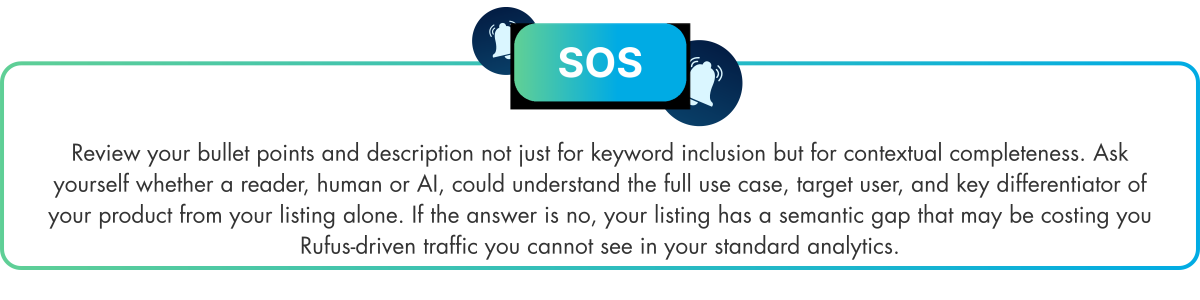
Semantic SEO also supports the longer-term health of your organic rankings. As Amazon continues to develop its AI shopping infrastructure, the listings that are written with clarity, context, and intentional structure will accumulate a compounding advantage over those built purely around keyword stuffing. The sellers who adapt their content strategy now are building a durable SEO asset, not just chasing short-term ranking gains.
The most common miscalculation sellers make is treating Amazon SEO as a launch activity rather than an ongoing operational function. Listings are optimized at launch, then left static for months or years while the competitive landscape shifts around them.
What sellers think is happening: "My listing is optimized. The keywords are in place. I just need to run ads."
What is actually happening: Competitors are actively refreshing their keyword strategies, running A/B tests through Amazon's Manage Your Experiments tool, and using Search Query Report data to identify gaps in your indexing. Every month you hold static is a month they close the ranking gap.
A second common error is conflating indexing with ranking. Being indexed for a keyword means Amazon knows your product is relevant to that search term, while ranking for a keyword means your product appears in a position where shoppers actually see it. These are two different outcomes that require two different strategies. Steps 1 and 2 address indexing, Steps 3 and 4 address ranking.
A third error is running PPC campaigns on keywords your listing is not yet indexed for organically. Paid traffic on an un-indexed keyword does not improve your organic position. It generates temporary visibility at full ad cost with no compounding SEO benefit. The correct sequence is to establish organic indexing first, then reinforce with paid traffic once the listing has demonstrated relevance.
Amazon SEO in 2026 is a competitive discipline. The sellers who treat it as a structured, progressive system rather than a one-time task are the ones who build durable organic traffic that reduces ad dependency and protects margin over time.
The 4-step framework OSS has developed is designed to meet sellers where they are. Steps 1 and 2 are appropriate for any seller looking to establish a stronger keyword foundation, Step 3 requires a mature listing with existing organic traction, and Step 4 is for brand-registered sellers ready to use Amazon's own data to compete for category-level market share. Layered on top of all four steps, semantic SEO is the forward-looking discipline that will increasingly determine which listings win in an AI-influenced search environment.
Each step compounds the one before it. The sellers who start early and build systematically are the ones who find themselves in positions 1 through 19 when their competitors are still wondering why their PPC spend keeps climbing.
Contact OSS to discuss which SEO step is the right starting point for your catalog.
We are your Amazon experts who provide comprehensive solutions and guidance to drive e-commerce businesses closer to success.
%20Cover%20Pic%20Template%20(2).png)