Unfulfillable inventory
Units marked unsellable for damage, defects, expiration, or customer returns
Amazon FBA Inventory
Amazon flags your units as unfulfillable or reserved without saying whose responsibility it is, so you can’t tell which next step is safe.
Amazon marks your units unfulfillable and you don’t know why
Units sit in reserved longer than they should
Received quantities don’t match what you shipped
Inventory was removed or disposed of without your say
You’re unsure whether to create a removal order
A damaged unit, a stuck reservation, and a receiving mismatch can all look like lost stock, and we trace each one to its source.
Units marked unsellable for damage, defects, expiration, or customer returns
Units held back by documentation, safety, recall, or policy issues
Units stuck in reserved longer than expected
Shipments where received quantities don’t match what was sent
Units lost or damaged in Amazon’s network, reviewed for reimbursement eligibility
Removal orders, auto-removal settings, and disposals made without your approval
It means unsellable inventory, units that Amazon inspected on arrival or after a return and deemed unfit for sale, which are then set aside for removal.
Common reasons include defects, damage caused by the customer, the warehouse, the carrier, or the distributor, and expiration dates too close to arrival. Amazon shows a reason we use to determine who is responsible.
Not necessarily, because once you remove or dispose of units, it can be harder to reconstruct evidence for a possible reimbursement. Amazon also expects action after it notifies you, so we review the case first and tell you which move best protects your options.
Reserved units are temporarily unavailable because of customer orders, fulfillment center processing, or transfers, and they aren’t automatically lost, but an unusually old reservation or one that doesn’t match your orders deserves a closer look.
Compare what you sent with what Amazon received, keep your box records and carrier proof, and we will review the evidence and reconciliation timing so we raise the case at the right moment instead of repeating it too early.
It can if your automated unfulfillable settings are set to dispose, and units flagged for certain condition or compliance reasons may also be removed, so we review whether the disposal was valid and what options remain.
Where Amazon’s eligibility rules point to a possible reimbursement, we review the case and handle it, though we can’t guarantee Amazon’s decision since each claim is evaluated on its own evidence and timing.
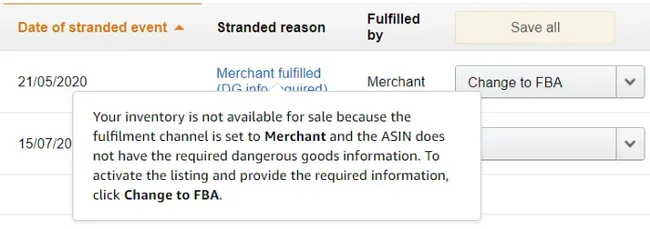
No, stranded inventory has its own service, because it comes down to listings and offers rather than unit condition, so if your units are stranded, visit our Stranded Inventory page.
Every project starts with a diagnostic where we review your statuses and reports, identify the cause, and tell you whether a path forward exists. You only need to share what you already see in Seller Central, and if a path exists, you receive a quote for the work.
No one can guarantee how Amazon responds, so we diagnose first to see whether a clear path exists before you commit.